Christmas of 2023, Russia finally completed its destruction of the town of Marinka. Without Russia’s invasions in 2014 and more recently in 2022 it’s likely that this essentially unremarkable place would have passed through history unnoticed. Nobody of international prominence was born there, and it harbored no special resources or qualities and little strategic consequence. It did have great economic and sentimental significance to the families that lived there, and came (over the course of two years) to mean a great deal to me as I visited and got to know some of the extraordinary people living — can we call it living? We can — in that small and unfortunate place. One in particular had a great impact on me; a man of his time, whom I had the privilege to meet.
It wasn’t until my second visit to Marinka that I met Vasyli. Gregarious and charismatic, with the fashion sense of a late 20th century Italian-American Brooklynite, Vasyli was described to me as an influential character. This is precisely the sort of person I like to meet while traveling for business or pleasure. He had a fruit orchard, the produce from which he distilled and bottled copious amounts of high-quality liquor. He was generous with these bottles. On each of my next four visits, I made a point of stopping in to see him and his wife whenever they were available. I even wrote a poem in his honor:
The Master of Marinka serves his booze,
A spirit that once tasted, none refuse
fermented juice distilled in ancient style,
With fruit extracted from his domicile,
A burning throat at every mouthful quaff
Its maker chases with a hearty laugh,
This whisky is the envy of the land,
All Donbas hails the Master’s artful hand.
If this seems lame or excessive, when you find yourself near the front lines, with the occasional gunfight breaking out nearby and bullets whizzing overhead, should you find someone who makes high quality booze and is essentially unbothered by what’s going on around and refuses all assistance, you let me know how that inspires you.
Vasyli’s back story was this: he’d ended up in Marinka in the mid-1980s, by way of Odesa. As a young man, Vasyli had embarked on a career in making alcoholic beverages, publicly and successfully working his way to the head up a state-run vineyard. In the 1970s, the USSR had invested in the region to compete with Italian, Californian, and French wine — so as not to deprive the communist worker from their own quality product.
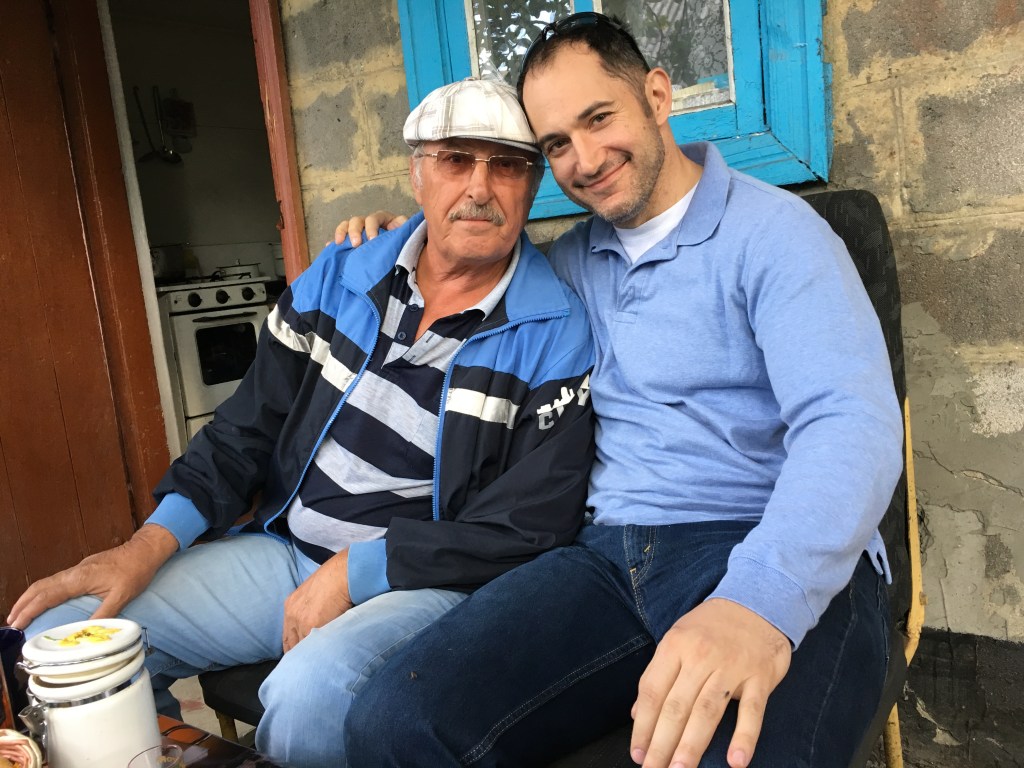
Live by the grape, die by the grape: just as the USSR’s nascent wine industry was catching on, Gorbachev instituted the Soviet Union’s version of prohibition. Vasyli and people like him, who’d been heroes just days earlier, became enemies of the state the next. He left in disgrace, but not before watching tractors tear up hectares of carefully-cultivated Odesan vines. He swore then never to make alcohol for anyone but himself, his family, and his friends. His organizational and chemistry skills were put to work at Marinka’s milk factory, churning out boxed milk for children, a far cry from Vasyli’s first great love.
By the time I first visited, in 2016, the milk factory was closed. Everywhere bore the scars of ongoing fighting: the school’s walls and windows were fortified with sandbags; buildings and apartment walls were scorched by fire and blast damage; a lively pigeon-breeding culture involving dozens of or even hundreds of skycutter pigeons had been placed on life support, decaying coops the only evidence of what had once been.
Here is what I had to say about the place and the war in 2017, for The New York Times.
Marinka was one of those places where people had been knocked down by the death of the coal industry in Ukraine, which had more or less corresponded with the collapse of the USSR. When the war happened, people took sides; most of Marinka sided with Ukraine. Russian-led paramilitaries took the town in April of 2014; Ukraine recaptured the town in August of the same year, and retained it until the end of 2023.
When I visited Marinka for the first time in 2016, it was while enroute to Mariupol, a stop between more important places. The fate of the two places has been similar, with capitulation coming only at the end of a brutal and destructive slugging match. Given its proximity to Russia, one can’t help but be amazed that Ukraine was able to hang onto Marinka as long as it did.
Now Marinka is gone; reduced to rubble and ruined buildings, dust, bullets, shell casings, and roving packs of starving dogs; it’s a hellscape, essentially, uninhabitable. No children roam its schoolyard. Vasyli’s orchard is razed, his house wrecked, the tub where he distilled elite-quality homemade liquor cracked and filled with mud and worse.
For his part, Vasyli and his wife are elsewhere — Kyiv or Dnipro, probably, nobody could tell me for sure, only that they’d left when the town was evacuated. All he wanted was to live out the rest of his days with his wife, retired, growing fruit and vegetables on his own land, and using the product of that labor. But he considered himself Ukrainian, living in the country of Ukraine. That’s a crime, incompatible with Putin’s vision for the place. For this crime, for wanting to be free, Marinka was destroyed, and Vasyli’s orchard and home are ruined.
What a pity!
 The Local Blind Spot