It’s Skunk Time

We have a skunk in our yard, now. It lives in an area beyond our fence, overgrown with weeds, vines, and thorns, and it navigates its way in each morning to hunt for grubs, grunting and snuffling through the long green grass as is its portly habit. We don’t begrudge it its meals, nor do we attempt to interrupt its course; we simply endeavor not to provoke its impressive tail. The skunk is part of our natural habitat, and we are only incidentally a part of its habitat, no matter how many houses or condominiums go up in the town of Branford, Connecticut.

There are skunks abroad, too—it seems to be the time for them. I’m talking here about the misguided and ludicrous attempt by a handful of former Army special forces veterans at loose ends, and a mob of disgruntled military defectors to topple the government of Nicolas Maduro.

Emailed or texted to me from veterans across the political spectrum—progressives like myself, centrists furious with how the Trump administration is smearing America’s good name by sanctioning or tacitly condoning groups like Silvercorp, and conservatives who want the coup carried out by active duty special operations with support from the Navy and Air Force—the bumbling failure has occasioned mirth and merriment from all, and gone some way to breaking down barriers erected by political grandstanding.

No comedy would be complete without a fool as its central character, and Jordan Goudreau delivers. A grifter who got his start peddling private security to schools in the aftermath of Parkland, Goudreau’s vision extended much further than protecting a bunch of boring, needy kids. There’s no glory in that. No, Goudreau had his sights on a world-historical gesture; indeed, during a strange video interview, he referenced Alexander the Great in describing his motivations for initiating the assault. It wasn’t Gaugamela, he isn’t Alexander, and his mission will go down in history as a farce that makes the Bay of Pigs invasion look deft by comparison.

(An aside: King Alfred the Great’s defense of Wessex from the Danes starting within the swamps of North Petherton would have been a better historical reference point, even though it would mean inverting Maduro (the man seen as legitimate political leader of Venezuala by a majority of Venezualans) and Juan Guaido (a man supported primarily by foreign powers, including our own, the U.S.))

Goudreau’s absurd attempt to hustle his way to becoming the military leader of an entire country doesn’t come from nowhere. Yes, he’s a grifter whose specific con is violence. Yes, he’s successful enough in a certain context to parlay his military connections into security gigs for President Trump, as recorded in a typically wonderful Bellingcat piece (another side note: Bellingcat established that Russian led separatists shot down flight MH-17 over Ukraine! Eat the whole fucking thing, don’t just eat the parts you like, Russia). Yes, he has the ambitions of an Alexander or a Julius Caesar… yes. And in America, today, a man with that kind of vision and pride, that appetite for power, let’s call it by its name, is in precisely the correct place to fill his ambitions. This is the America of freedom, of getting wealthy. The War on Terror has furnished a population of well-trained warriors who have been indoctrinated into the redemptive potential of murder in the name of God, or America. And the exploitative and specialized economy has made it so that even in the best of times when those warriors try to find an honest job, a vessel into which to pour their skill and strength, they’re mostly limited to jobs in law enforcement, private security, and shadier overseas work that pays extremely well, and leaves one to care for the cost of PTSD and any other injury that’s incurred when (or if) one gets home.

Even that, the modern American mercenary economy, is a kind of pyramid scheme. What Goudreau had in the back of his head when he established SIlvercorps was probably Erik Prince’s glimmering (and lucrative) intelligence and armed empire, formerly called Blackwater and currently called Academi (names shift in this business, staying one step ahead of whatever catastrophe or moral outrage the mercenaries have stumbled into at the moment) sounds good enough when you’re signing up: $150,000 a year to drive a truck through the desert? $200,000 for 6 months of work securing a compound outside Tripoli from disorganized militias? Comrades who had successful careers or stints with the Rangers, the SEALs, or, like Goudreau, the Green Berets? What’s the downside?

One downside is that those companies don’t owe their employees or contractors medical care after service. Another is that going to Iraq or Yemen or—in this case—Venezuala as a mercenary might mean you get paid, and might mean you get nothing. There are other, smaller annoyances, such as being hung out to dry completely when a mission goes south, as the Green Berets in Venezuala are about to discover.

Finally, serving in the U.S. military affords you some essential social credibility—legal credibility too, yes, but more importantly, you’re taking part in something that the entire country is engaged in. That, whether one likes it or not (many don’t) is the ultimate price of living in a democratic system, with elections: ultimately, whether you voted for the president or not, he’s your president, and the things done in America’s name belong to each and every American in equal portion. This is why although I protested against invading Iraq, I also joined the military after our invasion. This is why I didn’t vote for George W. Bush, but accepted my commission from a deputy of his. When a democratic country decides to act, there is some legal accountability that resides in every citizen. Not even captive subservience to two corporate and self-interested institutions like the Democratic Party and the Republican Party can totally erase that essential truth—a truth that separates the U.S. from men like Jordan Goudreau.

And there have always been lunatics like Goudreau in U.S. history. Aaron Burr, the former Vice President famous for killing Alexander Hamilton, later set out to build an empire with 60 adventurers (similar numbers to those trained and led by Goudreau’s SIlvercorp comrades). Millennial protestant evangelical Christianity combined with the cult of liberty and seasoned with radical capitalism have and will always lead certain people, covetous of power, to stab at prominence. Elizabeth Holmes, Bernie Madoff. Warren Buffet. The books are full of successful world-devourers, and some, like Jeff Bezos, even own their own newspapers. Why wouldn’t they continue to emerge?

Still, there’s something peculiar about Goudreau emerging now, specifically, and being able to go as far as he did. Prince emerged from the Bush administration, and a war in Iraq that had spiraled far beyond what even disinterested and distant architects like Rumsfeld and Bremer had imagined. Dick Cheney, the Vice President, with ties to Halliburton and KBR—companies worth billions, that provide hundreds of millions of dollars worth of service to the U.S. military every year to this day—was Erik Prince’s template. Cheney was (and is) the sort of parasitical beast who makes wars to make money—whose greatest ambition is to have a bigger Cadillac Escalade than his neighbor, to have a wall full of plaques, to be feared because of his wealth. Prince started out with a lot, and cannot be described as a “self-made man,” but he did something with that wealth—he saw an opportunity, and was, in his own way, a man “of his time.” He built a contracting company, a brand, and it makes him a lot of money. It gets him a seat at the table with the big boys.

Prince built an evil institution whose very purpose is an anti-enlightenment, anti-humanist affront to the democratic American project. Mercenary groups that allow governments to wage war without invoking war, without voting, without deliberation and assent. He did so at a time when the democratic project was busily being undermined by corporations at every turn, when large multinational corporations were laying the legal groundwork for Citizen’s United.

Goudreau, too, is a “man of his time,” every bit as much as Prince was of his. Goudreau’s gambit to overthrow Venezuala must certainly have been tolerated by Colombia’s government, which is to say, it must have been tolerated by the CIA, and the State Department, and the United States. We can say without being conspiratorial or indulging in fantasy that an operation like this, tweeted at the White House while ongoing, was something that was known, if not actively supported. Goudreau is one of those people who rises to power, if he can seize it, when there is no central authority saying that one cannot do so. Trump, a meglomaniacal narcissist who shits on a gold toilet, is Goudreau’s model, in the same way that Cheney is Prince’s.

There is a poem by W.S. Merwin, in his 1967 collection The Lice, called “The Last One.” In it, a desire to cut down an entire forest unleashes an malignant force that overcomes everyone who comes up against it—that force, which is not nature, is the very greed that propelled people to cut the forest in the first place. Here’s a section from the end:

Well the next day started about the same it went on growing.
They pushed lights into the shadow.
Where the shadow got onto them they went out.
They began to stomp on the edge it got their feet.
And when it got their feet they fell down.
It got into eyes the eyes went blind.
The ones that fell down it grew over and they vanished.
The ones that went blind and walked into it vanished.
The ones that could see and stood still
It swallowed their shadows.
Then it swallowed them too and they vanished.

We are at a precarious moment in American history, with our people, with our laws, with our ways. Humanity is precarious, because people die—good people die, evil people die, and the only way to circumvent this fact and create history is to make something capable of enduring beyond death (“the shadow”). Donald Trump is, whether he knows it or not, telling men like Jordan Goudreau that they should aspire to godhood, and that these dreams of dominion are sufficient to protect them from failure and catastrophe. They can’t, and won’t.

A Means to an End

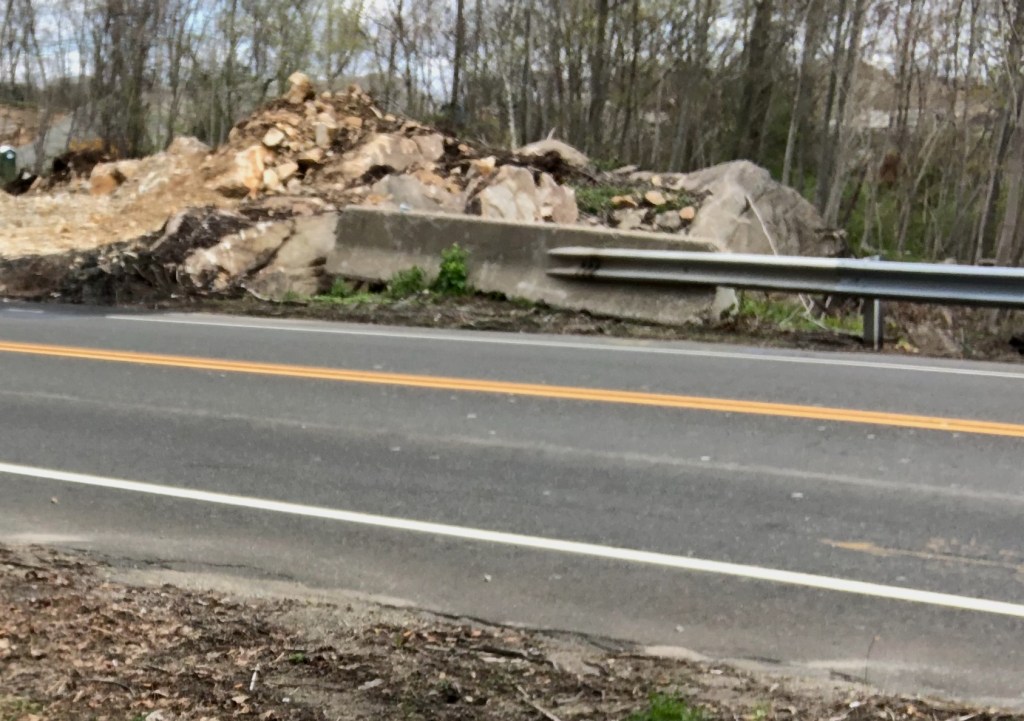
A plot of land in my home town between I-95 and Route 1 has been under development for about thre years. When developers started in on it, I was irritated that the place was going to be torn up for no apparent good reason. During my lifetime—and maybe even before that—the plot had been a series of massive granite boulders, bramble, and trees, unsuitable for cultivation, forestry, or business. It served a dual purpose as land that could be turned into something of economic or social viability, and also, less importantly, as home to dozens of common birds and squirrels.

Now, most of the trees have been cut, the brambles cleared, the land leveled, and the mighty, massive granite stones are systematically being turned into high piles of gravel and fill for other development projects. The land is being made useful for economic purpose—a grocery store perhaps, or a place to get gadgets fixed.

A development project on Route 1 in Connecticut is just another means to an end, rather than an end unto itself.

From the perspective of the developer, who owns a plot of land on Route 1, it’s easy to see why the trees and boulders and brambles had to go—no value was being created. Probably, he was paying taxes on the land. Probably, he saw Route 1 as a convenient place for economic development: cars and motorcycles pass by, while trucks transit I-95 from the other side. What more could a developer, what more could a businessman ask for?

From the perspective of the town’s treasurer and its chamber of commerce—a perspective shared by some of the town’s citizens—a development project and the business that follows is the bottom line, it’s the object. Life begins when one has something undeveloped on which to build, and, on a certain level, it culminates when that thing has been developed and turned into a profitable business. One measures this progress by checking the town’s budget: how much tax it has collected, versus how much tax it needs. My town is not special in that it functions like this, many towns do. Many towns must, in the United States of America, and in Europe, and in many other places, too. It’s a condition of the modern world.

Driving by the development site recently, I noticed that work had been put on pause; like so many other projects across the world, halted by the spread of COVID-19. Half-made into whatever it will become, the once-whole rocks scraped and broken by human ingenuity, gravel piled high, the area reminded me not so much of its potential, but of an irreversible decision to move from one state to another, progress, change, the urge to do something rather than nothing—and for what?

***

The climax of Christopher Nolan’s Batman: The Dark Knight, in which lawful Batman is pushed to the limit by an amoral and anarchistic Joker, involves a prisoner’s dilemma-style trial. Two ferryboats, one full of citizens, a ‘good’ boat, and another of prisoners, a ‘bad’ boat, are rigged with explosives, and authorities on each boat are given the means to detonate the other boat. Joker provides instructions to the boats: each will be able to rescue themselves only by destroying the other boat. If neither boat destroys the other, Joker himself will sink both boats at midnight.

By the time midnight rolls around, and the boats have elected not to destroy each other, Batman has arrived to stop Joker from detonating them both. External action is needed to preserve the lives of the people on the boat, but that was also always going to be true, two boats full of people can’t defeat Joker physically, they can only thwart his plan by refusing to play by the rules.

It is this refusal that is interesting, this deliberate choice not to act, not to destroy in order to preserve. On a moral level, acting to destroy is, in fact, the worst thing one can do. Still, the audience and the people on the boats understand that there is some hope for them; they can act to destroy the other boat and through this horrible act, at least preserve their own lives. “Noone wants to get their hands dirty,” a nameless civilian trapped on the ‘good’ ferry says with a minute to go before midnight. “Fine, I’ll do it.” He stands up, and rationalizes why he ought to sink the other boat, takes the detonator from a captain in the national guard, looks up at the clock, hesitates, and then—nothing. He lays the detonator down in its case, and returns to his seat. He and everyone else on the boat are now resigned to their fates

This is the true climax of the movie—the rest of it is a series of plot resolutions and exposition on the significance of what the audience has observed. Two groups of people decide not to murder in a way that benefits them—not to “take action”—and in so doing they both save and condemn themselves.

***

The startling scenes of heroic inaction in Batman: The Dark Knight are among the film’s most moving. There is a cost, a sacrifice being made—but it is truly selfless; a willingness to have the self destroyed in an unpleasant and painful way, in order to preserve some hypothetical moral integrity for the self. Of all the strange and extraordinary moments in the movie—the explosions, the exciting tricks and gadgets deployed by Batman and his allies, the clever plans and counter-plans, the threats and deaths and carnage—the prisoner’s choice is the part that most stands out, that defies expectations.

In the logic of the movie, we understand the civilians and the prisoners can’t blow each other up, it makes no sense, but in our own personal lives, we know the opposite is true. We know that America invaded Afghanistan after 9/11, and Japan after Pearl Harbor, we know that Israeli special operations hunted down Nazis for prosecution and revenge, we know that it doesn’t take a deranged madman holding us prisoner to want righteous vengeance. We know, too, that what is necessary in a situation like that is action, is to do something quickly, decisively, and heroically—and that we’ll sort out the mess afterwards.

Someone needs to get their hands dirty.

***

The quarantine that has stopped so much economic activity around the world is confusing precisely because it cuts against what we expect to have to do. The heroic sacrifice to which people are accustomed, the grand gesture, that’s not needed. Quarantine threatens the underlying assumptions we’ve held about what constitutes good or productive behavior. Sacrifice is supposed to be long hours at work, a bigger house, a successful career. Heroes are recognizable by their acts; doctors and nurses without enough PPE to go around, or multinational CEOs who have efficiently commanded their own time and that of others to create value.

Sacrifice is not supposed to be nothing, and quarantine is precisely and exactly that, nothing. Not going out, not buying, not shopping. Not “self-improvement,” not education—it can be those things, but isn’t necessarily, the end of quarantine is simply the negation of public activity, or, otherwise, inactivity. Quarantine doesn’t involve developing land, or building (unless it’s building temporary capacity in hospitals), or making deals. Sacrifice, like action, is supposed to be tied to progress in some economically measurable way; the stock market going up, or a country getting stronger. It’s not just sharing hardship—that, by itself, is attached to and signifies nothing. Quarantine is nothing, and entails a sacrifice of negation.

More than anything, the unsettling position in which Americans find themselves now, of having to do “nothing” while the economy slows and one’s job becomes precarious or is deemed redundant, explains why there’s so much enthusiasm for an end to the quarantine, in spite of the death and illness such an action might cause. People—Americans in particular, to judge from my town and surroundings—are accustomed to “doing,” to “getting things done.” The entire economy and culture is geared to this way of thinking, from one’s professional life, to one’s family, to how one productively spends one’s vacation seeing notable sights, or having useful experiences. The economy depends on this activity, and individuals depend on this activity, as well. It is how the world goes around, especially an economically and socially interconnected world, a global world rather than a local or parochial or individual world.

But what is needed now is inaction, forbearance, husbanding one’s resources (and family). The urge to get back to work, to become productive, has been exposed not as heroic or useful, but selfish—solipsistic—and in the current context, counterproductive. What does that say about the system, writ large? This pandemic is part of life, pandemics (far worse) have occurred before in human history, we are not living in an exceptional moment. Shutdown is normal, and it isn’t evil or awful. It simply is.

Going back to work will solve nothing, and could make the pandemic worse. Being productive is only likely to accelerate infection and death, but that’s not a revelation that’s natural to us. We do not understand that the means to our survival lies in embracing a way of life and moral framework that’s completely counterintuitive. Or, we do know, and we fear that accepting that embrace, in the present, will mean learning something that cannot be unlearned—never, in other words, going back to the world as it was before COVID-19.

***

It’s not possible to make things whole again on that plot of land on Route-1 in Branford, Connecticut. It’s true that the area will serve no purpose for the foreseeable future: it can’t, nobody’s there to work the machines to clear the gravel or brush, and even if there were, there’s nowhere to move it—progress and commerce has stopped. What was land that served no use has become an industrial sore on the land, a reminder of a moment in time when someone thought it would be better to develop, to move and create, than to leave be, than to do nothing, for nothing’s sake. In the old world, before COVID-19, we thought inaction was a costly sin. In our current world, we’re learning that the opposite may be true.