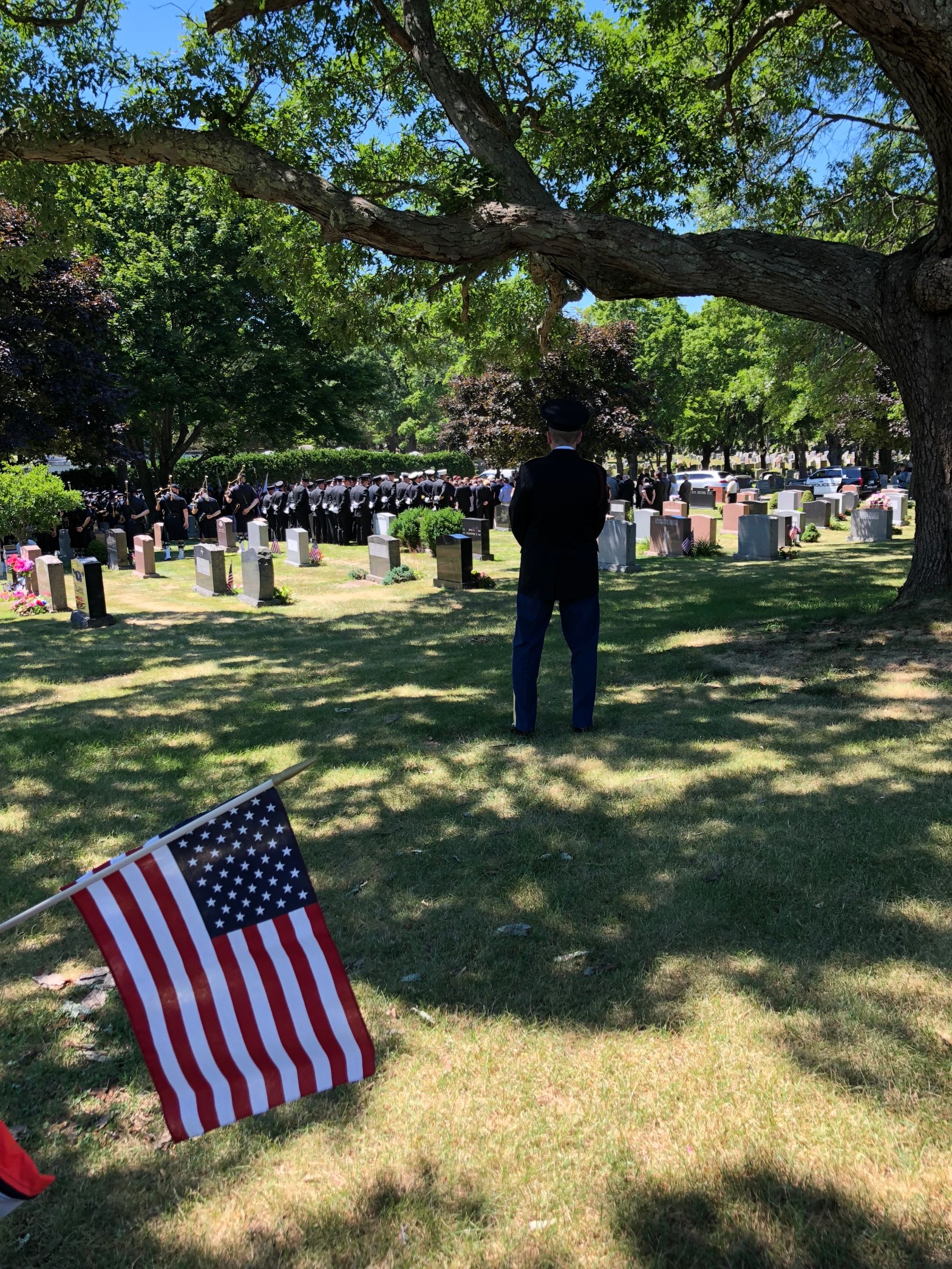
There is an idea that many Americans who have served and those who have not hold about war. It goes something like this: if the war was important, if it was a real war, I’d serve. I’d join and fight the enemy. I didn’t join and fight in Iraq, or Afghanistan, or Iran, because those weren’t real wars. But the Nazis, I’d fight. I’d fight the Russians or the Chinese. I’d fight to defend my home.
To properly appreciate Memorial Day, it’s important to acknowledge a basic fact. Most people don’t serve in the military even during the biggest, most difficult wars. In the larger wars of the 20th century, a lot of folks contribute to national defense in one way or another, but comparatively few serve. Direct service in the U.S. during WWII reached something like 12%. And between 15-20% of that 12% saw combat.
In Ukraine today, something like 7% of the population has served or is serving in their current war of defense against Russia. This is widely seen as a struggle that is, for the Ukrainians on par with the resistance to Nazi Germany in WWII, a fight for existence against a foe that wishes to see Ukraine destroyed and Ukrainians expelled from their land.
So the majority of people in a country thinking that they’d join the military to go to combat in a real war are deluding themselves. For one reason or another, they wouldn’t fight. They might serve, they might work in national defense, but the odds are great that even in a very large war, a world war, they wouldn’t seek out combat.
Last Memorial Day I walked in the city of Stamford’s parade and spoke at their Memorial Day Ceremony. The subject of the speech dealt with the etymology and origin of our word “true.” It’s a good speech, and I encourage folks to watch the YouTube video. The short version is — our word “true,” which we take to mean objectively and scientifically verifiable, originally meant “the loyalty displayed by a warrior who shows up to fight when called by their leader.”
Before we had science and the scientific revolution, in a world that was far less peaceful than today’s, the only question that truly mattered was this one: would enough warriors show up to fight for their king or emperor when called? Many did not, would not, or could not. The outcome, for a people or nation where enough people did not show up to fight, has always been the same: that country, kingdom, nation, or tribe stopped existing.
In the U.S., our culture today has a very different approach to war than countries in centuries past. Overall, the culture views war as evil, rarely necessary (if ever), and service as something to be avoided if one can do anything else. People who are too eager to get to war are regarded with skepticism bordering on hostility.
But we maintain Memorial Day. Not as a way of remembering people who sacrificed their lives to protect the homeland, as that is not something that has been necessary in living memory for all but the very oldest living veterans, but as a way of honoring a sacrifice that most must view as abstract. We remember the fallen because of the idea of service, the idea of sacrifice. And most of us flatter ourselves to imagine that this is something we’d probably do if it was important enough, or that we could do (as in, we are physically or psychologically capable to serve in today’s military).
Years ago, I wrote on Memorial Day for Wrath-Bearing Tree about a soldier I’d served with, Adam Davis, who died during my first and his only deployment to Afghanistan, and his brother Tim, who also died, later, not having deployed to combat (but having served). I thought about the sacrifice Adam made, and Tim was willing to make but not in the precise way that the opportunity presented itself to him. I thought about the complicated way memory works, and how remarkable it is that I still remember Adam; ultimately not just because of his sacrifice, but also because I knew him, personally.
With time, and having seen the war in Ukraine, I’ve come to think more about the role Memorial Day plays in our society. I don’t think Memorial Day does the thing we think it’s supposed to be doing; I don’t know that we’re capable of appreciating the sacrifice these people have made in the past — decades and centuries ago. Many citizens can’t remember because they never knew the troops who died and even if they did, few endured the conditions that ended the troops’ lives.
I’d go further. I believe that it is a lie to claim that “a grateful nation” remembers, or even that a state or a town remembers, at least not in a way that is anything more than symbolic. I’m sure the families of fallen troops are grateful that their neighbors have an occasion on which to observe the sincerely noble sacrifice of their relatives. But our culture has done far more not to remember war than to perpetuate widespread understanding thereof. Instead, we obscure war behind layers of certification, professionalism, training, social derision, fiction, fantasy and other similar barriers. The people who speak about war, elected politicians and representatives, are rarely combat veterans themselves. If our culture has little knowledge of war, can it really expect citizens to memorialize those who fell during war?
The pillar on which my platform for Governor of Connecticut rests demands that our state and its towns and cities begin returning the culturally vital, historically necessary, and constitutionally guaranteed mechanism by which to understand war, and to prepare for it in an egalitarian way: a well-regulated militia, or what I call a voluntary state guard. This is the vehicle by which the Swiss survived centuries of attacks by their larger and more linguistically and ethnically homogenous neighbors; the device Ukraine is currently using today to hang on against a much larger, wealthier, and better-equipped invading Russia. It was essential to the American victory over Great Britain during our war of Independence. And the Founders saw service as inseparable from a healthy democracy. While not all of them saw combat, every one of them served the fledgling nation’s struggle in some capacity.
There are many reasons why people choosing to serve in their military is (not should be, is) necessary to a free people. And there are many ways to ensure that it is minimally invasive to a citizen’s enjoyment of their life. It should be more available and accessible, and it should encompass as many people as possible. In such a way, Memorial Day will not serve as a placebo, a nearly frictionless acknowledgement that others died for our freedom. The observance itself becomes a kind of prison, a privilege not to work on a particular day rather than a sobor reminder that the world is a violent and dangerous place, more violent and dangerous with each passing year. No — when service is widespread, Memorial Day will be a chance for us to look in the mirror and knowing from training and experience what goes into war, say that when the dangerous moment arrives, and we are asked to risk our lives so that our neighbors can continue on in peace, “I am ready to sacrifice my life.”
Alternately, that look in the mirror could yield a different revelation — “I am not willing to make that sacrifice” — which makes the sacrifice of others all the more compelling and extraordinary, and the admiration more profound.
If we do not (currently we do not) ask ourselves this, demand this of ourselves and our towns, cities, and our state, a time will come in our lives when war is imposed on us. We will not understand how to meet that moment. And too few people will be “true” in the way that our ancestors meant it. They won’t really understand why they should be true, or the stakes involved.
Most of the criticism I see around how people observe Memorial Day comes from military veterans and focuses on the lack of gratitude — that citizens should be engaging in sober contemplation rather than celebration and feasting. In this critique, which one can easily encounter online, citizens’ relationship to Memorial Day is flawed. Citizens should feel differently than they do.
But that isn’t what I’m trying to claim here. Citizens feel the way they ought to given what they know of the world around them. They’re not stupid, they’ve been systematically separated from military reality, from service. Many even still have an instinct to serve, but the aforementioned barriers to service are for various arbitrary reasons too great. The relationship between citizens and Memorial Day is a product of the way Americans fund and have organized their military since the 20th century. When the U.S. military — an “all volunteer force” in which troops must work hard to graduate from challenging schools and be fortunate enough to join the units most likely to see combat — suffers casualties in wars that are not seen as necessary by even a majority of the population, those casualties appear in some sense voluntary or contingent. Few people truly appreciate what that service meant, what it was for, or how it ennobled the various rights and freedoms to which American citizens are Constitutionally entitled.
I don’t think that Memorial Day is just about observing or remembering the deaths of people from the past. It is certainly about that, and specifically about the nature of their sacrifice. That they “answered the call,” as folks say — that they were true. Memorial Day is also a way to prepare ourselves for the future catastrophe that ultimately awaits every nation, and ours, too. We can be more or less prepared for the moment when it arrives. Eventually, it will.

