Recently I attended my 30-year reunion. Like colleges, prep schools hold reunions every five years. I don’t know if that’s the case with public schools, but it is for prep schools, which emulate colleges in all things.
It was well-attended. For a class that graduated about 100 people, I think 30 people showed up, plus or minus a few. Alums came from across the country. They showed up for a variety of reasons: reconnecting with old friends and acquaintances, seeing the school, or just taking advantage of an opportunity to, in adulthood, reexplore what it meant and felt like to be in a high school setting again.
Hopkins School is an interesting place. It’s wonderful in many respects, and I wouldn’t trade the experience of studying there for anything. Academically, the education was the best money can buy — I wouldn’t have studied as hard or loved English as well without the teaching and mentorship of Jim Bucar, Toni Giamatti, and Heidi Dawidoff. The extracurriculars pushed and stretched me as a young man. I acted in plays and sang in an a capella group, “The Harmonaires,” which produced an album that I think still stands up, all these years later. At athletics we were competitive without being dominant at anything. I ran cross country and played lacrosse, in both cases adequately; sports has always been seen at Hopkins as a means to an end (that end being the socialization and education of young men and women), rather than an end unto itself. Participating in sports was good. Athletics did not, as it does at some schools, unduly distort the social life of the school.
No — the social life of Hopkins revolved around the college you got into, and from which you graduated. From my class of 100, around 40 earned undergraduate degrees from what’s called now “Ivy plus,” including 12 from Yale. If one includes people who went on to get a second degree from an Ivy plus school — a Master’s or a JD or MD — the number’s probably closer to 50 or even 60. If one expands “Ivy Plus” from places like UChicago and Stanford to include the small but exquisite liberal arts colleges such as Bowdoin, Swarthmore, Amherst, Williams, and Middlebury, the number is probably closer to 80 or even 90.
There was an insane amount of emphasis placed on this, internally and externally. I can’t speak for my classmates, but the stress I felt to go to a place that I felt matched my ability, and not just any place, but Yale specifically, was extraordinary. To this day, I have more anxiety dreams about being at Hopkins having to retake some test to graduate than I do anxiety dreams about being in combat in Afghanistan.
I would rather be patrolling looking for Taliban than retaking a French or Calculus final.
If you were to offer me a choice between fighting the Taliban and studying French, rational Adrian would choose French 10/10 times. That’s no choice at all! But the degree to which being a student at Hopkins impressed me as an adolescent is still active in my subconscious. That feeling of terror, which I also felt as a student at Yale, and in Ranger School, and at all the other places I’ve worked since, compelling me to work a bit harder than I might have otherwise, is still a part of me. Terror at the idea of failure, of not measuring up.
The faces of my classmates unblocked a dam of memories. My psyche flooded with painful and pleasant recollections; friendships, people who had done me kindness, others who I abruptly remembered had slighted me in ways real and imagined. It was like rereading a book one had read decades ago in another place in one’s life. Hopkins was a chapter in my life, an early one. Graduates were bound together in some ephemeral sense, although we had all taken different directions since.
In remembering the personal and the precise, the imperfect mixture of ambition, social structure, identity, and personal integrity that determined the trajectory of my classmates’ lives not just in school but also afterwards, I came to think of the milieu we inhabited. Because while not every class thinks of themselves as special, or regards themselves somehow as such, the class of 1996 did see themselves as special in a way that the class of 1995 did not, and (as far as I know) the class of 1997 and 1998 did not, either. There was a sense that our class was part of a destiny that would encompass not just our own futures, but also the future of America. This is not to say that we were objectively a special class, but we saw ourselves this way, and believe that others around us saw us that way, too.
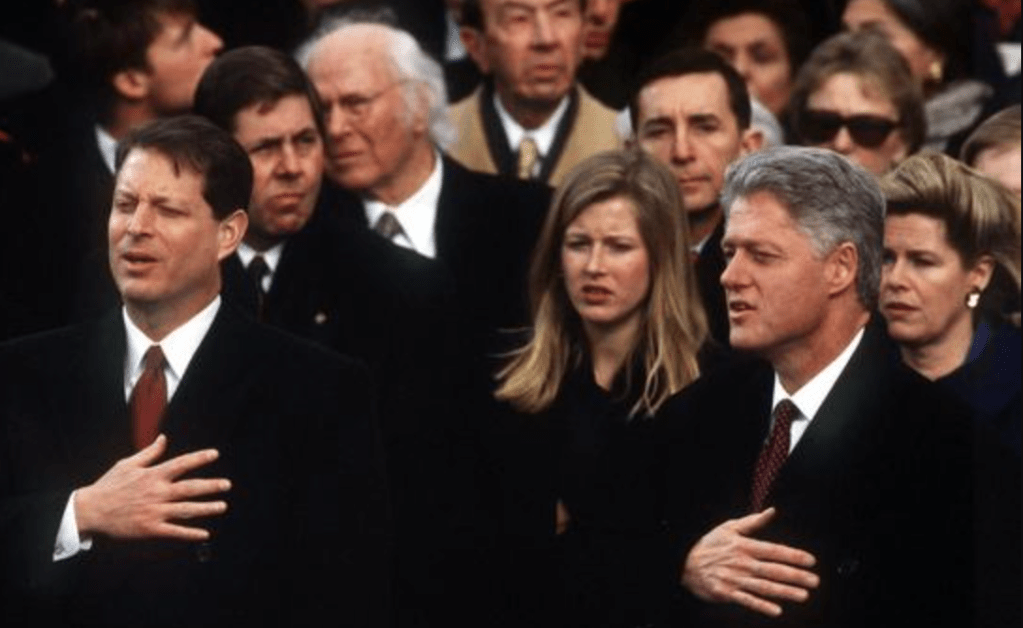
Here, it’s important to consider where we were in 1996 as a country and as a culture. The U.S. was at the peak of its power and influence — the USSR not only having collapsed (in 1991) but by 1996, having fallen into ruin. Clinton was on the verge of winning a second term as president, dismissing Bob Dole (easily, as it turned out), the last WWII combat veteran to run for president and second, after George H. W. Bush, to be defeated by “Slick Willy”. The internet was taking off as a mainstream phenomenon thanks to AOL. We were graduating high school at the very moment that the world was changing and, in a key difference from contemporary dread at the prospect of AI hitting the economy like a mile-long meteor hitting Earth, the overwhelming feeling at the time was one of optimism — that we would be helping herald in a new era of peace and prosperity.
What has our class done with this mandate? After decades of working, we are coming into power; we are in or near positions of real influence. Those of us who are artists and writers have been creating art and writing for decades. Those of us who are in politics or have various careers in law, medicine, and science have come to occupy places where we can determine the course of our university departments; of our local towns, our states, our nation, and the world. We can direct money to invest in our children’s future.
And so — what? What is it that we have contributed, that we will have the opportunity to contribute? Not just from Hopkins, but across the country, what good is it that we’re preparing ourselves to achieve, for our communities? How will that energy and optimism — that obsessive drive to succeed — manifest itself at a moment when the U.S. seems more divided and conflicted and challenged than ever? Lower than ever? Will we be able to help America deliver on those idealistic promises that we felt were essential when we graduated?
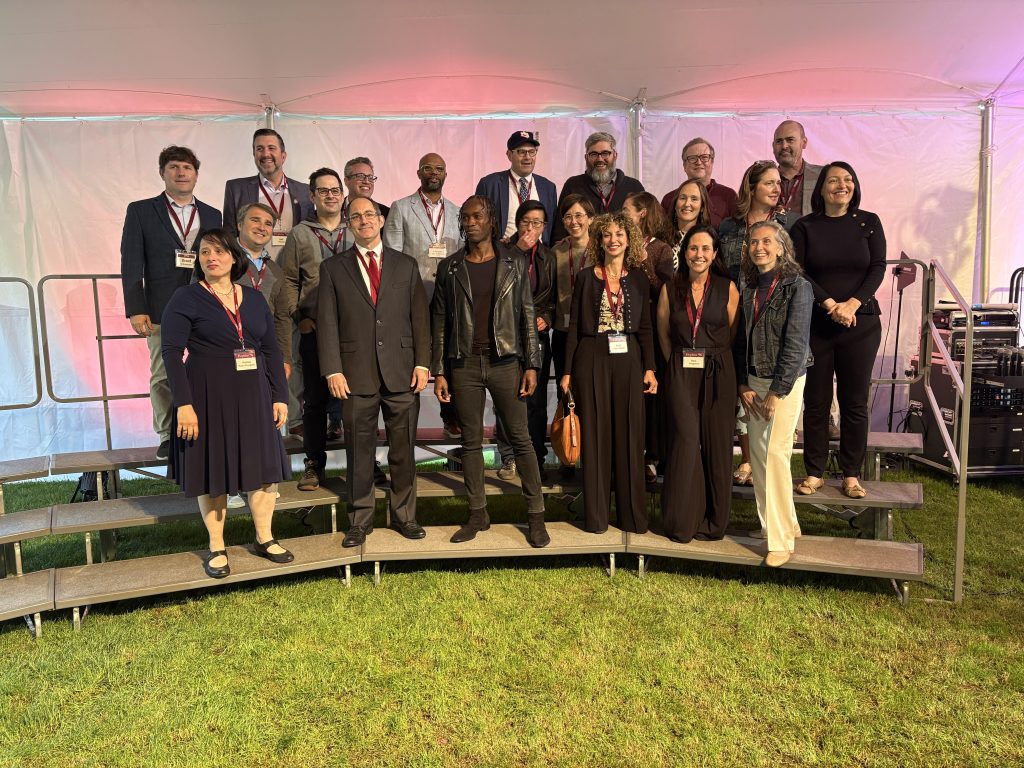
In another 30 years, we’ll know; we’ll be able to gauge how it all turned out. I hope I’m around to see it. I’m still optimistic. In spite of the complexity and the fear, or perhaps because of it, while I can imagine us failing, I can’t accept that I will do anything less than my utmost to prevent America’s rot and collapse. Just because progress appeared easy or foreordained or locked in during the 1990s, and is now contested by reactionary forces around the world, does not mean we can’t make a real difference for the better.

